
 ▶ Video
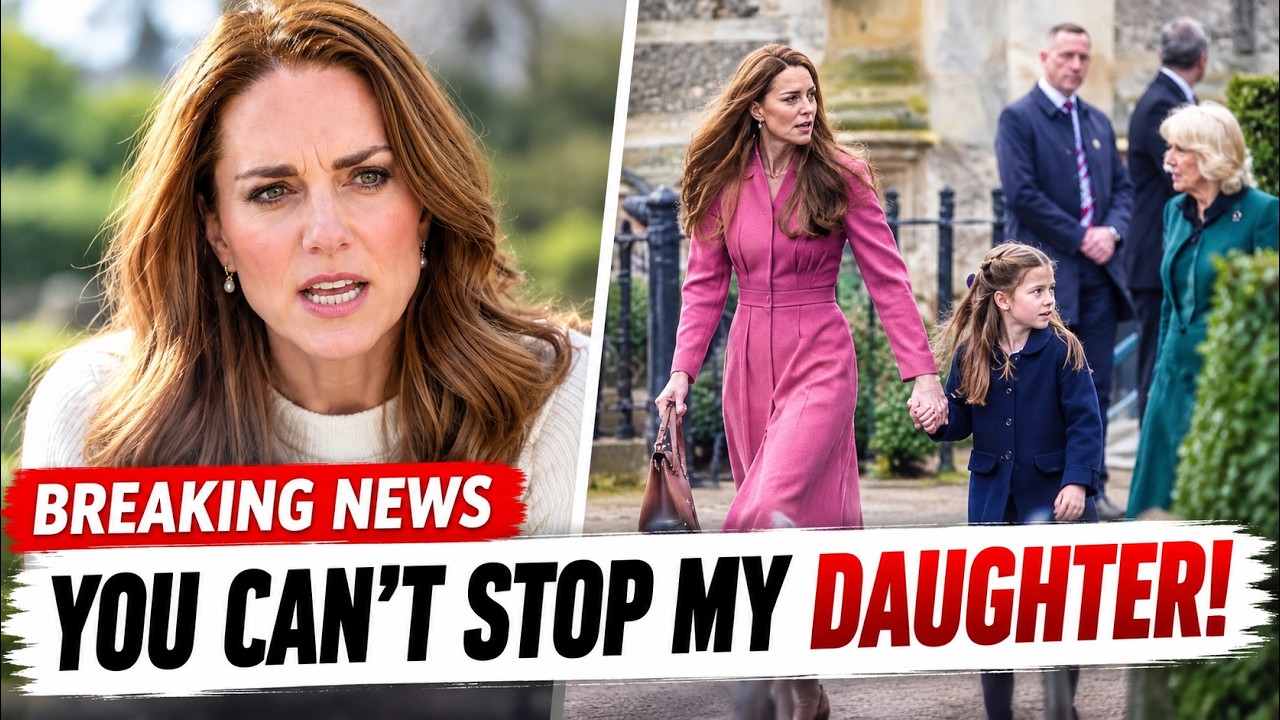
It is the fact that according to accounts, Catherine did not argue in the room, did not release a statement, did not attempt to spin the narrative. She simply assessed the situation, recognized that her daughter was being exploited as a pawn in a strange power struggle and departed. That is the detail that sets this apart from the typical royal rumor mill. When one examines what was actually said versus what actually transpired, the entire episode resembles a very quiet, very personal act of defiance. Before delving into the complexities of it all, take a moment to subscribe to Crown. We analyze these royal situations every week so you don't have to sift through palace statements on your own. So here is the setup. Windsor Castle, a private ceremony intended to be a grand moment of continuity. The imagery was meant to convey unshakable unity, the crown's bright future, all of it. And Princess Charlotte was supposed to be part of it. She had a role. She had practiced. She knew where to stand. For a 9-year-old, that is significant. It is not merely about waving at cameras. It is about feeling that you belong within this vast ancient institution. And then just before they were about to enter the grand chamber, an equy, essentially a trusted royal aid, stopped them in the corridor. He could barely look at Catherine and he informed her that Charlotte could not proceed through the next doorway. At first, one might assume, all right, a last minute schedule change. Delays do happen. But no, the order reportedly came directly from Queen Camila. And that is where it becomes strange. If the order were merely about logistics, why would it not have been communicated before the family arrived? Why wait until they are literally in the hall with Charlotte in her dress, ready to go? The timeline does not add up. If you are removing a child from a ceremony, you do it before she is standing there with her place card printed. You do not do it in a cold stone corridor where the child can hear every word. Charlotte apparently asked her mother whether she had done something wrong. That is the kind of question that stays with you. Catherine knelt down on the floor, told her she had done nothing wrong, and then made a decision that likely alarmed every aid in the room. She removed her ceremonial badge, placed it on a table, and stated that her family would not participate. No argument, no pleading, no waiting for permission. She simply left. Now, William was already inside near the front of the gathering. When he learned what had happened, he did not remain for the ceremony. He walked directly toward Camila. And that is another detail that feels significant because William does not typically engage in public confrontation. He has been very careful over the years about not allowing private family tension to spill into official events, but when it involves his daughter, that carefulness disappears. The report states he placed an amended attendance sheet on a table between them and demanded one answer. Why was his daughter excluded? And Camila's defense was that Charlotte's role had never received her final approval. She accused Catherine of treating a temporary arrangement as a guaranteed right. She said the Wales household was acting as though Charles's reign were merely a waiting room for William and Catherine. Honestly, the fact that she would not simply answer the question is the strange part. Instead of saying, "I made a mistake." She turned it into a referendum on the Wales family's popularity. That is not a reason to remove a child from a ceremony, that is a reason to have a private conversation about one's own insecurities. And a report says Charlotte was not merely moved in the program. Her name was deleted and replaced before the family even arrived. Her spot in the procession went to a young relative linked to Camila's family. That is not a scheduling conflict. That is a power move. and it backfired spectacularly because Catherine did not simply walk out of Windsor. She went home and began crossing names off future events. The report says she sat at the kitchen table with William after the children had gone upstairs, reviewed their schedules, and drew a line through Charlotte's next appearance at Windsor. Then she crossed out two more events that included all three children. No public statement, no dramatic announcement, just a quiet, firm boundary. Until the palace could guarantee that her children would not be used as tools in adult conflicts, they would not be participating in ceremonial events. That is a mother's counter strike. It is not about punishing the institution. It is about changing the rules of engagement. And this is where the story becomes truly interesting from a family dynamics perspective. Charles apparently sat alone with the original and revised attendance list, studying the crossed out name. He removed his glasses, rubbed his nose. He knew this was not merely about one ceremony. It was about who had the authority to issue orders within the household. Camila had managed to transform a personal resentment into an official act. And Charles, for all his reputation of avoiding conflict, had to intervene. He suspended the official who carried out the removal. He demanded a full review of every instruction related to the event and he ruled that no child from the Wales household could be excluded from any future royal engagement unless both parents were informed beforehand with a clear reason. That is a fairly significant shift. It means Camila's authority within the household has limits and Charles was finally willing to enforce them. But here is the thing. The damage had already been done. Charlotte had already sat in an armored car, silent, clutching a program in which she had drawn a line through her own name. The report says she told her mother she did not want anyone else to remove it. That is a 9-year-old attempting to take control of a situation that made her feel invisible. And Catherine told her that no seating plan could define whether she belonged in her own family. It is a beautiful sentiment, but it does not erase the hurt. Charlotte had arrived, ready to serve, dressed correctly, practiced in her boughs. She left feeling as though another powerful woman had made her feel secondary. And if you are Catherine, that is the part you cannot forgive because she knows the history. She knows what happened to Princess Margaret. What happened to Prince Harry? She knows the spare role can carry a heavy emotional burden. And she was determined that Charlotte would never feel as though her place depended on pleasing powerful adults. Now, let us discuss the broader pattern here because this is not the first time Camila's influence has been questioned. Reports have circulated for years about her attempting to position her own family members in prominent roles. The fact that Charlotte's spot went to a young relative linked to Camila's family is telling. It suggests this was not about protocol at all. It was about who gets to stand close to the crown. And when you look at it that way, the whole thing becomes less about a single ceremony and more about a deeper fear that William's young family makes the current reign look temporary. Camila reportedly said the ceremony represented the current adult household, not the future reign. That is a revealing statement. It implies that Charlotte, simply by existing and being visible, was a threat to Camila's sense of relevance. And that is where I genuinely do not understand the logic. If you are the queen consort, your position is secure. You do not need to erase a 9-year-old from a procession to prove your authority. In fact, doing so makes you look exactly like the kind of person who would erase a 9-year-old from a procession. It is self-defeating. The empty chairs at the ceremony became a silent accusation. Every missing Wales family member pointed back to the decision. And the palace's first attempt at damage control, suggesting Charlotte was simply overwhelmed, was rejected by William immediately because he knew that narrative would make his daughter look fragile or unprepared, and he was not going to let that stand. The report says Charles asked to meet Catherine alone. She agreed, but with one condition. They would not discuss publicity or damage control. They would only talk about Charlotte. That is a power move in its own right because it reframed the entire conversation around the child's experience, not the palace's image. Catherine described how Charlotte nervously waited outside the ceremonial chamber, asking whether she had behaved badly. She described how the young princess crossed out her own name on the program and Charles apparently looked away. He realized that his granddaughter should never have felt that love and belonging depended on strict ceremonial approval. And Catherine told him something important. The family can handle disagreements about roles. But once a child is humiliated, staying silent is not neutrality. It is complicity. That is a direct challenge to the royal instinct to avoid conflict at all costs. And it seems to have worked. Charles apologized to Charlotte. He promised to restore her place in the family discreetly. He assured Catherine that his actions would not erase past mistakes, but would clarify her rightful position. And then he announced a smaller family service where Charlotte would carry her floral emblem with Catherine by her side. One week later, Charlotte returned to Windsor, walking confidently with her mother. Charles took a moment to apologize to her directly, acknowledging the adults mistake, and affirming her place. Camila attended, admitted her previous decision was wrong, and offered Charlotte the original ceremonial badge. That is a significant concession. It does not undo the hurt, but it is an acknowledgement that the decision was wrong. Catherine accepted, but made it clear that her children's dignity was non-negotiable, and Charles set new palace rules. Any changes involving George, Charlotte, or Louie would require their household's consent. That is a structural change. It means Camila cannot unilaterally decide to remove a child from an event again. It means the whale's household has formal protection against this kind of power play. And it means the monarchy, at least in this instance, was forced to adapt to a mother's boundary. What is striking about this entire story is how quiet the rebellion was. Catherine did not scream. She did not leak to the press. She did not even issue a statement. She just left. And then she quietly withdrew her children from future events until the institution changed its behavior. That is not dramatic. That is discipline. And it is probably more effective than any public fight could have been because when you refuse to participate, you remove the thing the institution needs most, the image of unity. When the whales family is not there, the cameras notice, the public notices, the empty chairs become the story, and no amount of palace spin can fix that. The fact that Camila's own aids reportedly preferred silence after the leak of the empty chair photo is telling. They knew acknowledging the internal dispute would make it worse, but silence was no longer an option. The question of where Charlotte was had already begun circulating, and Charles had to answer it. He confirmed that Charlotte was expected at the ceremony, and that her removal had prompted new protections for royal children. That is a rare admission of internal dysfunction. It is not the kind of thing the palace usually confirms, but the story had already grown too large to ignore. And here is the larger implication. This was not just about one ceremony. It was about whether the monarchy could protect its future while using its youngest members as pawns. Charlotte's role in that procession was symbolic. Her removal was symbolic. And her return, walking with her head held high, was symbolic, too. But the real change was structural. The new rules meant that no adult could unilaterally decide a child's place based on their own insecurities. and that is a shift that will outlast this particular scandal. Catherine's refusal to hide suffering behind tradition forced the institution to acknowledge something it usually ignores. That children are not props, that their emotional well-being matters as much as their ceremonial roles, and that a mother's boundary can be more powerful than a queen's command. William watched Charlotte begin the procession, her place restored, while Camila respectfully stayed back. That image, the future king's daughter walking forward while the queen consort steps back, is a quiet declaration of where the power really lies. Not in titles or seating charts, but in the willingness to say no when something is wrong. And that is the thing that stays with me. Catherine did not win this by outmaneuvering Camila in palace politics. She won by refusing to play the game at all. She took her daughter's hand and walked away. And in doing so, she changed the rules. The crown demands loyalty, but it cannot silence a mother when her child feels shame. That is the lesson here, and it is one the palace will not forget anytime soon. The empty chair at Windsor became a symbol not of Charlotte's absence, but of the cost of treating a child like a chess piece. And the fact that the chair was filled again with Charlotte carrying her floral emblem and her mother by her side is a reminder that some boundaries are worth holding even against a thousand years of tradition. But let us return to that corridor moment because I think it deserves more attention. The Equiry who delivered the message was apparently one of the most experienced aids in the household. He was not some junior assistant who got his lines crossed. He knew exactly what he was saying and he still could not make eye contact with Catherine. That detail tells you everything about how the order was perceived internally. The staff knew it was wrong. They knew it was humiliating and they knew it was coming from a place of personal grievance rather than any legitimate ceremonial concern. When even the messenger is ashamed of the message, the whole thing is rotten from the start. Catherine's decision to kneel down and speak directly to Charlotte in that hallway was also more significant than it first appears. Royal children are often spoken about in the third person, even when they are standing right there. Adults discuss their schedules, their behavior, their roles, as if they are not listening. Catherine broke that pattern. She made the conversation about Charlotte's feelings first, not about the ceremony or the protocol or the insult to the Wales household. She told her daughter she had done nothing wrong before she even addressed the aid again. That is a mother who understands that the emotional impact of the moment matters more than the political implications. And then there is the walk out itself. It was not a dramatic exit. Catherine did not slam doors or raise her voice. She simply removed her ceremonial badge, placed it on a table, and said her family would not participate. The badge is important. It is a symbol of official inclusion of being part of the royal machine. By taking it off, Catherine was signaling that she was no longer playing by the machine's rules. She was not rejecting the monarchy. She was rejecting the idea that her family's place in it could be revoked on a whim, and she did it in front of witnesses, which meant the story could not be buried or rewritten later. William's reaction was equally telling. He did not try to smooth things over or convince Catherine to stay for the sake of appearances. He went straight to Camila. That is a man who has spent his entire life learning to compartmentalize family drama to keep the public face intact no matter what happens behind closed doors. But this time the public face did not matter. His daughter had been hurt and he was not going to let the ceremony continue as if nothing had happened. The fact that he placed the amended attendance sheet on the table between them is such a restrained but pointed gesture. He was not shouting. He was presenting evidence. He was demanding accountability. Camila's response, according to the report, was to deflect. She said Charlotte's role had never received her final approval. She accused Catherine of treating a temporary arrangement as a guaranteed right. She said the Wales household was acting as though Charles's reign were merely a waiting room. None of that addresses the actual question. Why was Charlotte excluded? Why was her name removed and replaced without notice? Why was a child left standing in a corner asking whether she had done something wrong? Those are the questions that require answers. And Camila did not have any. It is also worth noting that this was not an isolated incident. The report suggests there had been smaller slights before. Little tests of authority that Catherine had mostly ignored. A seating adjustment here. A schedule change there. Nothing as blatant as removing a child from a ceremony, but the pattern was there. Camila had been pushing boundaries for some time, attempting to establish that her position as queen consort gave her authority over the entire household, including the Wales family's children, and Catherine had been patient, perhaps too patient. This was the moment that patience ran out. The kitchen table scene is the part that feels most real to me. Catherine and William sitting together after the children had gone to bed, reviewing schedules, crossing out events, no public statement, no dramatic announcement, just two parents deciding that their children's emotional safety mattered more than ceremonial obligations. That is a very ordinary moment in the middle of an extraordinary situation. It is the kind of thing any parent would do. And that ordinariness is what makes it so powerful. The monarchy is built on tradition and hierarchy and the idea that personal feelings must be set aside for the greater good. But Catherine's response was rooted in something more fundamental. A mother's refusal to let her child be treated as a pawn. The fact that she crossed out three events is significant. It was not a total withdrawal. She was not refusing to ever bring her children to royal engagements again. She was setting specific boundaries until the palace could guarantee that her children would not be used as tools in adult conflicts. they would not participate. That is not a tantrum. That is a negotiation strategy. And it worked. Charles's response was slower than it should have been, but it did come. He sat with the lists. Studying the crossed out name, he removed his glasses. He knew this was not just about one ceremony. It was about who had the authority to issue orders in the household. Camila had overstepped and Charles had to decide whether to support his wife or protect his granddaughter. He chose Charlotte. He suspended the official who carried out the removal. He demanded a full review and he ruled that no child from the Wales household could be excluded from any future royal engagement unless both parents were informed beforehand with a clear reason. That is a structural change. It means the rules are different now. It means Camila's authority has limits. But the damage had already been done. Charlotte had already sat in that armored car, silent, clutching a program in which she had drawn a line through her own name. That image is heartbreaking. A 9-year-old attempting to process rejection by physically marking it on paper. She told her mother she did not want anyone else to remove it. She wanted control, and Catherine told her that no seating plan could define whether she belonged in her own family. That is true, but it does not erase the hurt. Charlotte had arrived ready to serve, dressed correctly, practiced in her bows. She left feeling secondary. And if you are Catherine, that is the part you cannot forgive because Catherine knows the history. She knows what happened to Princess Margaret, who spent her life struggling with the limitations of being the spare. She knows what happened to Prince Harry, who left the royal family entirely, citing the emotional toll of being treated as less important than his brother. She knows the spare role can carry a heavy emotional burden and she was determined that Charlotte would never feel as though her place depended on pleasing powerful adults. That is not just about one ceremony. That is about a lifetime of selfworth. The broader pattern with Camila is also worth examining. Reports have circulated for years about her attempting to position her own family members in prominent roles. The fact that Charlotte's spot went to a young relative linked to Camila's family is telling. It suggests this was not about protocol at all. It was about who gets to stand close to the crown. And when you look at it that way, the whole thing becomes less about a single ceremony and more about a deeper fear that William's young family makes the current reign look temporary. Camila reportedly said the ceremony represented the current adult household, not the future reign. That is a revealing statement. It implies that Charlotte, simply by existing and being visible, was a threat to Camila's sense of relevance. But that logic does not hold up. If you are the queen consort, your position is secure. You do not need to erase a 9-year-old from a procession to prove your authority. In fact, doing so makes you look exactly like the kind of person who would erase a 9-year-old from a procession. It is self-defeating. The empty chairs at the ceremony became a silent accusation. Every missing Wales family member pointed back to the decision, and the palace's first attempt at damage control, suggesting Charlotte was simply overwhelmed, was rejected by William immediately because he knew that narrative would make his daughter look fragile or unprepared, and he was not going to let that stand. The meeting between Charles and Catherine is another key moment. She agreed to meet him alone, but with one condition. They would not discuss publicity or damage control. They would only talk about Charlotte. That is a power move in its own right because it reframed the entire conversation around the child's experience, not the palace's image. Catherine described how Charlotte nervously waited outside the ceremonial chamber, asking whether she had behaved badly. She described how the young princess crossed out her own name on the program, and Charles apparently looked away. He realized that his granddaughter should never have felt that love and belonging depended on strict ceremonial approval. And Catherine told him something important. The family can handle disagreements about roles. But once a child is humiliated, staying silent is not neutrality, is complicity. That is a direct challenge to the royal instinct to avoid conflict at all costs. And it seems to have worked. Charles apologized to Charlotte. He promised to restore her place in the family discreetly. He assured Catherine that his actions would not erase past mistakes, but would clarify her rightful position. And then he announced a smaller family service where Charlotte would carry her floral emblem with Catherine by her side. One week later, Charlotte returned to Windsor, walking confidently with her mother. Charles took a moment to apologize to her directly, acknowledging the adults mistake and affirming her place. Camila attended, admitted her previous decision was wrong, and offered Charlotte the original ceremonial badge. That is a significant concession. It does not undo the hurt, but it is an acknowledgement that the decision was wrong. Catherine accepted, but made it clear that her children's dignity was non-negotiable, and Charles set new palace rules. Any changes involving George, Charlotte, or Louie would require their households consent. That is a structural change. It means Camila cannot unilaterally decide to remove a child from an event again. It means the whale's household has formal protection against this kind of power play. And it means the monarchy, at least in this instance, was forced to adapt to a mother's boundary. The quietness of the rebellion is what makes it so effective. Catherine did not scream. She did not leak to the press. She did not even issue a statement. She just left. And then she quietly withdrew her children from future events until the institution changed its behavior. That is not dramatic. That is discipline. And it is probably more effective than any public fight could have been. Because when you refuse to participate, you remove the thing the institution needs most, the image of unity. When the whales family is not there, the cameras notice, the public notices, the empty chairs become the story. And no amount of palace spin can fix that. The fact that Camila's own aids reportedly preferred silence after the leak of the empty chair photo is telling. They knew acknowledging the internal dispute would make it worse, but silence was no longer an option. The question, where was Charlotte was already circulating and Charles had to answer it. He confirmed that Charlotte was expected at the ceremony and that her removal had prompted new protections for royal children. That is a rare admission of internal dysfunction. It is not the kind of thing the palace usually confirms, but the story had already grown too big to ignore. And here is the larger implication. This was not just about one ceremony. It was about whether the monarchy could protect its future while using its youngest members as pawns. Charlotte's role in that procession was symbolic. Her removal was symbolic. And her return, walking with her head held high, was symbolic, too. But the real change was structural. The new rules meant that no adult could unilaterally decide a child's place based on their own insecurities. And that is a shift that will outlast this particular scandal. Catherine's refusal to hide suffering behind tradition forced the institution to acknowledge something it usually ignores. That children are not props, that their emotional well-being matters as much as their ceremonial roles, and that a mother's boundary can be more powerful than a queen's command. William watched Charlotte begin the procession, her place restored while Camila respectfully stayed back. That image, the future king's daughter walking forward while the queen consort steps back, is a quiet declaration of where the power really lies. Not in titles or seating charts, but in the willingness to say no when something is wrong. And that is the thing that stays with me. Catherine did not win this by outmaneuvering Camila in palace politics. She won by refusing to play the game at all. She took her daughter's hand and walked away. And in doing so, she changed the rules. The crown demands loyalty, but it cannot silence a mother when her child feels shame. That is the lesson here, and it is one the palace will not forget anytime soon. The empty chair at Windsor became a symbol not of Charlotte's absence, but of the cost of treating a child like a chest piece. And the fact that the chair was filled again with Charlotte carrying her floral emblem and her mother by her side is a reminder that some boundaries are worth holding even against a thousand years of tradition. So, what do you think? Was this a calculated power play by Camila or just a catastrophic misjudgment? And did Catherine handle it the right way? Or should she have made a more public stand? Let me know in the comments. I read every single one and I am genuinely curious how you see this one. And if you have not already, subscribe to Crown Watch and turn on notifications so you do not miss the next breakdown because something tells me the story is not over yet. The palace may have closed the book on this particular incident, but the tensions that caused it are still there simmering beneath the surface. And when they boil over again, you will want to be watching.