
 ▶ Video
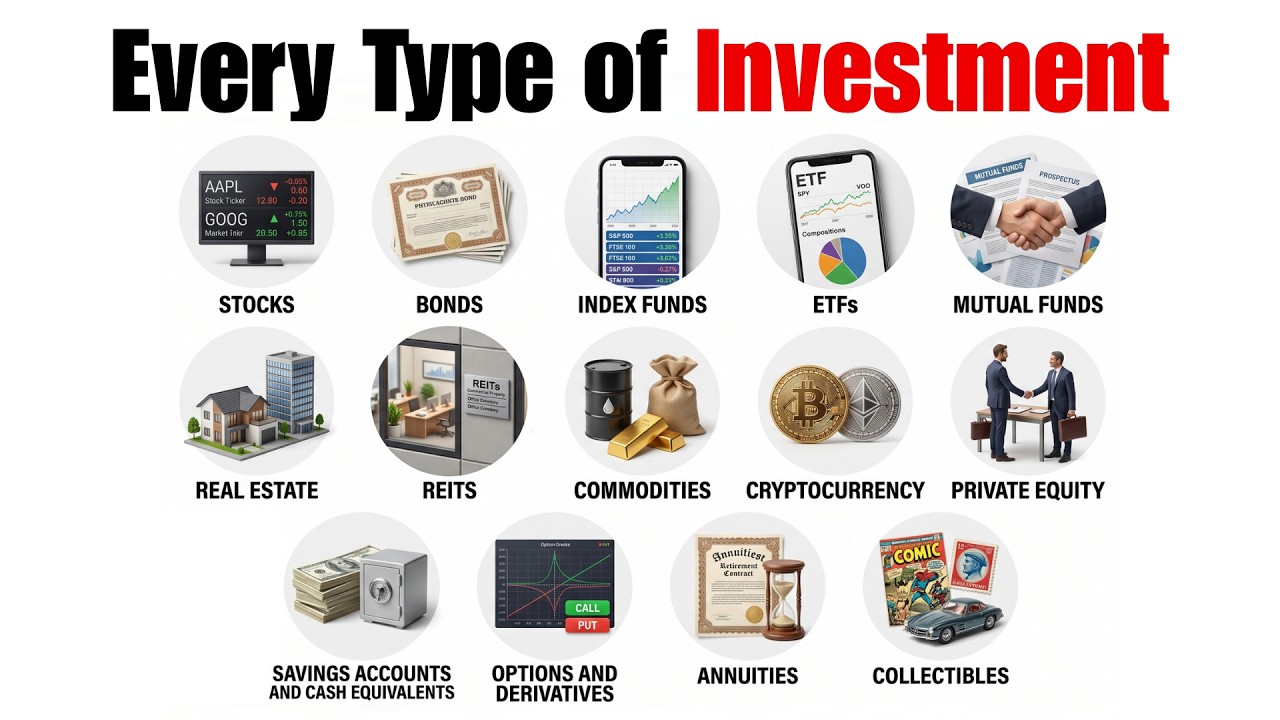
You leave the money where it is. And every month inflation quietly eats a little more of it. Here is every type of investment. What it actually is, how it works, and what kind of person it is actually built for. Stocks. A stock is a small piece of ownership in a company. When you buy a share, you become a part owner of that business.
If the company grows, your share becomes more valuable. If it struggles, your share loses value. Individual stocks are high- risk, high potential return. Most professional fund managers cannot consistently beat the market by picking individual stocks. Most individual investors do worse than professional fund managers. That is not an argument against stocks. It is an argument for understanding what you are buying before you buy it. Bonds. A bond is a loan you give to a government or company. They borrow your money, pay you interest at regular intervals, and return your original amount at the end of the term. Bonds are safer than stocks because the return is predictable and fixed. The trade-off is that the return is lower. Safety costs something. Government bonds from stable governments are among the safest investments in the world. Corporate bonds carry more risk because companies can fail. High yield bonds, also called junk bonds, offer higher interest rates to compensate for higher default risk. Bonds are the stabilizing force in most portfolios. They do not grow aggressively. They protect what is already there. Index fund. An index fund is a collection of stocks designed to mirror the performance of a specific market index, like the SNP500, which tracks the 500 largest US companies. Instead of picking individual companies, you buy a tiny slice of all of them at once. When the market goes up, the index fund goes up. When the market goes down, the index fund goes down. You are not trying to beat the market. You are trying to be the market. Index funds have lower fees than actively managed funds because the computer just mirrors the index. No analysts required. Over long periods, most actively managed funds fail to outperform index funds after fees. Simple, diversified, lowcost, long-term. ETFs. An ETF, exchangeraded fund, is similar to an index fund, but trades on a stock exchange like an individual stock throughout the day. ETFs can track indexes, sectors, commodities, bonds, or almost anything. Technology companies, clean energy, gold, emerging markets. The flexibility is the point. ETFs give you diversified exposure to an entire category of assets without buying each one individually. They typically have low expense ratios. For most investors, the practical difference between an index fund and an ETF is small. Both offer diversification, low cost, and broad market exposure. The ETF just gives you more flexibility on when and how you trade. Mutual funds. A mutual fund pulls money from many investors and uses it to buy a collection of stocks, bonds, or other assets. A professional fund manager decides what to buy and sell. You are paying for their expertise. That expertise comes with a cost. Mutual funds charge higher fees than index funds and ETFs. The core question is whether the fund manager's performance justifies the extra fee. Most of the time over long periods, the answer is no. A fund returning 8% annually but charging a 2% management fee is effectively returning 6% to you. That difference compounds significantly over decades. Real estate. Real estate is property you buy, expecting it to generate income, appreciate in value, or both. The most straightforward version is buying a property and renting it out. Tenants pay rent. Rent covers the mortgage. The property appreciates. Real estate requires more capital upfront than most other investments. It is illquid. You cannot sell a house in an afternoon the way you can sell a stock. It requires active management and it is geographically concentrated risk. Real estate has built more generational wealth than almost any other asset class in history. It has also destroyed people financially when purchased at the wrong price at the wrong time with the wrong amount of debt. REITs. A REIT real estate investment trust lets you invest in real estate without buying property. REITs are companies that own incomeroucing real estate, office buildings, shopping centers, apartment complexes, warehouses. They are required by law to distribute at least 90% of their taxable income to shareholders as dividends. You buy REIT shares the same way you buy stocks. The share price rises and falls based on the value of the properties the REIT owns and the income those properties generate. For investors who want real estate in their portfolio without a down payment or a tenant calling at midnight, REITs are one of the most practical solutions available. Commodities. Commodities are raw materials. Gold, silver, oil, natural gas, wheat, corn, coffee. You can invest directly by buying the physical asset or indirectly through futures contracts, ETFs, or commodity funds. Commodities behave differently from stocks and bonds. They often move in the opposite direction of stock markets, making them useful for portfolio diversification. When inflation rises and currency loses value, physical commodities like gold often hold or increase in price. The challenge is that commodities do not generate income. A bar of gold does not pay dividends. You make money only if the price goes up. Commodities are typically used as a hedge against specific economic risks rather than as a primary growth investment. Cryptocurrency. Cryptocurrency is digital money that exists on a blockchain, a decentralized system not controlled by any government or bank. Bitcoin, Ethereum, and thousands of others. The case for crypto is a new asset class with limited supply, growing adoption, and potential for significant appreciation. The case against it is no underlying cash flow, no earnings to analyze, no dividend to collect. The price is driven entirely by what someone else is willing to pay. Volatility is extreme. A 50% drop in a year is not unusual. A 90% drop has happened to multiple assets. Crypto can generate extraordinary returns. It can also go to zero. Most financial advisers suggest treating crypto as the highest risk portion of a diversified portfolio. Money you are prepared to lose entirely. Private equity. Private equity is investment in companies not listed on a public stock exchange. Venture capital backing early stage startups. Buyyou funds acquiring established companies to restructure and sell. Growth equity investing in companies between startup and going public. Private equity has historically delivered higher returns than public market. It has also historically been accessible only to institutions and ultra high netw worth individuals. The trade-off for higher returns is illquidity. Private equity investments are locked up for years with no ability to exit early. You cannot sell your stake the way you can sell a stock. It remains one of the most complex, least liquid, and least transparent corners of the investment world. Savings accounts and cash equivalents, high yield savings accounts, money market accounts, treasury bills, certificates of deposit. These are not growth investments. They are parking spots for cash that earn a modest return while remaining accessible and safe. No volatility, no risk of losing the principal, just a predictable, stable, boring return. Every investor needs some portion of their portfolio in cash equivalents for emergency funds, short-term goals, or as a buffer between riskier assets and your survival money. The mistake is treating a savings account as a long-term wealth-b buildinging strategy. It is not. It is the foundation that lets you take risks elsewhere. Options and derivatives. An option is a contract that gives you the right, but not the obligation, to buy or sell an asset at a specific price before a specific date. A call option lets you buy. A put option lets you sell. Options are used by experienced investors to hedge existing positions, protecting against downside risk, and by traders to speculate on price movements with significantly more leverage than buying the asset directly. The potential gains from options are large. The potential losses are equally large, sometimes unlimited. Options expire worthless if the price does not move in the direction you bet on. Most retail investors who trade options lose money. Options are a sophisticated tool that requires deep understanding of market mechanics, pricing models, and risk management before they belong anywhere near your portfolio. Annuities. An annuity is a contract between you and an insurance company. You hand over a lump sum of money. In return, the insurance company pays you a guaranteed income stream, either immediately or at a future date, for a set period, or for the rest of your life. Annuities are used primarily in retirement planning as a way to guarantee income when other investment returns are uncertain. The appeal is certainty. No matter how the market performs, the payments keep coming. The criticism is cost and complexity. Annuities often come with high fees, surrender charges for early withdrawal, and terms that are deliberately difficult to compare. They're also frequently misold, pushed by salespeople earning high commissions to people who do not fully understand what they are buying. Used correctly in the right financial situation, an annuity can provide real peace of mind. Used incorrectly, it is an expensive, inflexible product that locks up your money at the worst possible time. Collectibles. Collectibles are physical assets. Art, rare watches, vintage cars, trading cards, wine, sneakers, things people buy because they believe someone else will pay more for them in the future. Collectibles can generate extraordinary returns. A rare trading card bought for a few dollars decades ago might sell for hundreds of thousands today. The problems are significant. Collectibles generate no income while you hold them. They are highly illquid. Finding the right buyer takes time. Authentication and storage costs money. And the market for collectibles is driven entirely by taste and trend, not by earnings, cash flow, or any fundamental measure of value. A category that is hot today, NFTTS for example, can collapse entirely and leave holders with something almost nobody wants to buy. Collectibles work best as a passion investment, something you buy because you love it and if it appreciates, that is a bonus. Treating them as a core financial strategy requires a level of market expertise most investors do not have. Every type of investment, each one a different trade-off between risk, return, liquidity, and complexity. Nobody starts with all of them. Most people start with one. The point is not to find the perfect investment. The point is to understand what you are choosing and why.